Khai’s FNB Art Joburg Top Picks

Updated: Sep 15

It’s almost been a week since FNB Art Joburg wrapped, and a few pieces have stayed with me since.

Thato Toeba, Soon was a long time ago (2026)
Collage, mirror and found objects on wood.
Toeba trained as a lawyer before turning to collage about five years ago, and works mostly with found and donated photographs, old National Geographic issues, family photos, charity shop finds. A lot of that choice comes down to access. Much of Southern Africa's visual history from the colonial era ended up in European archives rather than local ones, shot by photographers who weren't from here. Working with found, leftover and secondhand images is one of the few ways to actually handle that history.
The shape got me first, cut with the same mix of jagged angles and soft curves as the individual photographs pieced together inside it, as if the whole work were just one more fragment of itself, scaled up. You have to move around it before you can even take in what's inside. Then the flood of photographs themselves, some that read as personal, others pulled from print and archive, weddings, tea tables, plastic garden chairs, a woman dancing in red, kids, elders, a television. Fragments of memory, stacked and overlapping rather than running in a straight line. So much of it felt familiar, like I'd seen these scenes before, or versions of them. Memories that weren't mine, but felt inherited anyway, a rhythm of Black Southern African life passed down. I think that was the point.
A brass crucifix sits at the centre of it all, a symbol of devotion passed down through generations, echoed in the photographs surrounding it - and mirror fragments are worked into the surface, so you see yourself reflected within it. Looking at myself in that mirror, I realised I'm standing inside the same continuity those photographs came from. They're history already, and I'm living the part that's still present, still happening, the same way those photographs once were, until the moment I walk away, then it becomes history too, another fragment of the same story, still being written.

Boyce Magandela, The Man of Visions (2026)
Threads and fabric on blanket.
Magandela was born in 1979, is Xhosa and originally from the rural Eastern Cape, now living and working in Cape Town. He trained at the Community Arts Project, working across ceramics, printmaking, painting and drawing, before turning to needle and thread on blankets, which in Xhosa culture aren't just for warmth, they carry meaning tied to heritage, ritual and ceremony.
The check blanket underneath this portrait is a specific one. Magandela has spoken about wanting to work with men and blankets because different blankets mark different life stages, and the check blanket in particular is the one elders give a young man to welcome him into adulthood. After a young man completes ulwaluko, the initiation into manhood, he's given a new, more formal blanket and dressed with a level of formality for a period afterward - the hat, the white collar, the structured jacket - the dress of a man newly come into manhood.
Against that formality, the face is the part that unravels. The face is made up almost entirely of loose, tangled thread, colour bleeding and knotting where the features should be composed. Only the gold lace at the blazer collar holds its shape, unexpectedly delicate against the unseen weight of the blanket and the directness of the man's gaze.
The clothing is symbolic of arrival, status, a role stepped into and settled. The face says the opposite, unresolved, still knotting itself together. It's less a portrait of a man than a portrait of what that unseen weight is expected to hold together on the inside.

Sanjo Lawal, Follow Who Know Road (2022)
Giclée print, fine art paper, 310g.
Lawal is a Lagos-based fine art photographer whose work draws directly from his mother, the fabrics she wore, the colours in the garden she kept. He works with fila and gele, traditional Yoruba caps and headwraps, and rebuilds them digitally into something closer to crowns than clothing. In his own words, these pieces are not just adornments, they are crowns, burdens, histories, and dreams, made in a world that often asks people to shrink.
Two flat black silhouettes move across a cobalt blue, comic-like backdrop with a flat, cartoonish sun, similar to the simplified skies of children's illustrations. The title 'Follow who know road' is Nigerian pidgin for trusting someone who's already walked the path. Here, that trust looks like being pulled forward, literally, one figure leading, one being pulled along. The front figure, in a wrapper printed with circular patterns, pulls the second figure forward, the second figure seated on a small wheeled cart, draped in shimmering teal, holding a stack of polka dot balloons, red, yellow, turquoise. Both wear towering, sculptural headpieces, exaggerated past anything functional, set against balloons, toy-bright colour, and comic staging. And at the bottom of both figures, Nike sneakers.
The Nikes sit right alongside the textile patterns and fila-inspired headwear, perhaps a suggestion that traditional identity was never meant to be a closed archive. Sneakers carry their own economy of status, desire, and pride, especially within black youth culture, where what's on your feet says as much about who you are as what's on your head. In this context, the fila and the Nikes both function as 'crowns', one carrying the weight of inheritance, history and obligation, the other the weight of the present moment. Here, in a world that ‘often asks people to shrink’, that weight intentionally comes dressed in colour, instead of solemnity and grimness.

Dada Khanyisa, A Crowd of Three: Album Cover
Carved wood, paint and mixed media relief
Khanyisa was born in Umzimkhulu in 1991, raised in Johannesburg, and now lives and works in Cape Town, where they completed a fine art degree at Michaelis in 2016. They think of themselves first as a "maker of things," working almost entirely in relief, hand-carving wood and building it up with paint and textile so figures physically project off the wall. They call their process nakanjani, Zulu for "by any means," a method built specifically to allow different materials and multiple outcomes rather than one fixed technique. Music runs personally through their life too, they've described their own record collection as serious enough that friends talk about it, and have said they're drawn to vinyl specifically because, unlike a digital file, it can't be deleted or locked away.
Khanyisa has said this piece is a direct reference to album covers of local bands from the 70s and 80s, specifically that pose, three or four members dressed alike, standing together for the shot. For them, it's a meeting point of the things they're consistently drawn to as a maker - pattern, movement, drapery, synchronicity, musical subject matter - arriving in one image. They've described the making of it as a fair balance between intuition and calculation, with colour led by an instinct for visual harmony rather than a plan set in advance.
This artwork as with the entire practice of Khanyisa, is an attempt to "write or dictate or archive a moment or capture a moment," as they would put it, made specifically because no one else is documenting South African youth and social culture as it happens, before it's gone. This piece extends that same instinct into music. Album covers already hold onto an era, sound, design, a specific moment in local culture, and vinyl in particular has stayed physical while so much else has gone digital and disposable. Khanyisa takes that same act of holding on and carries it into another form, carving it into wood, sculptural, tactile, physical in a different way. It's memory being reimagined for a contemporary audience, given a new kind of permanence alongside the one it already had.
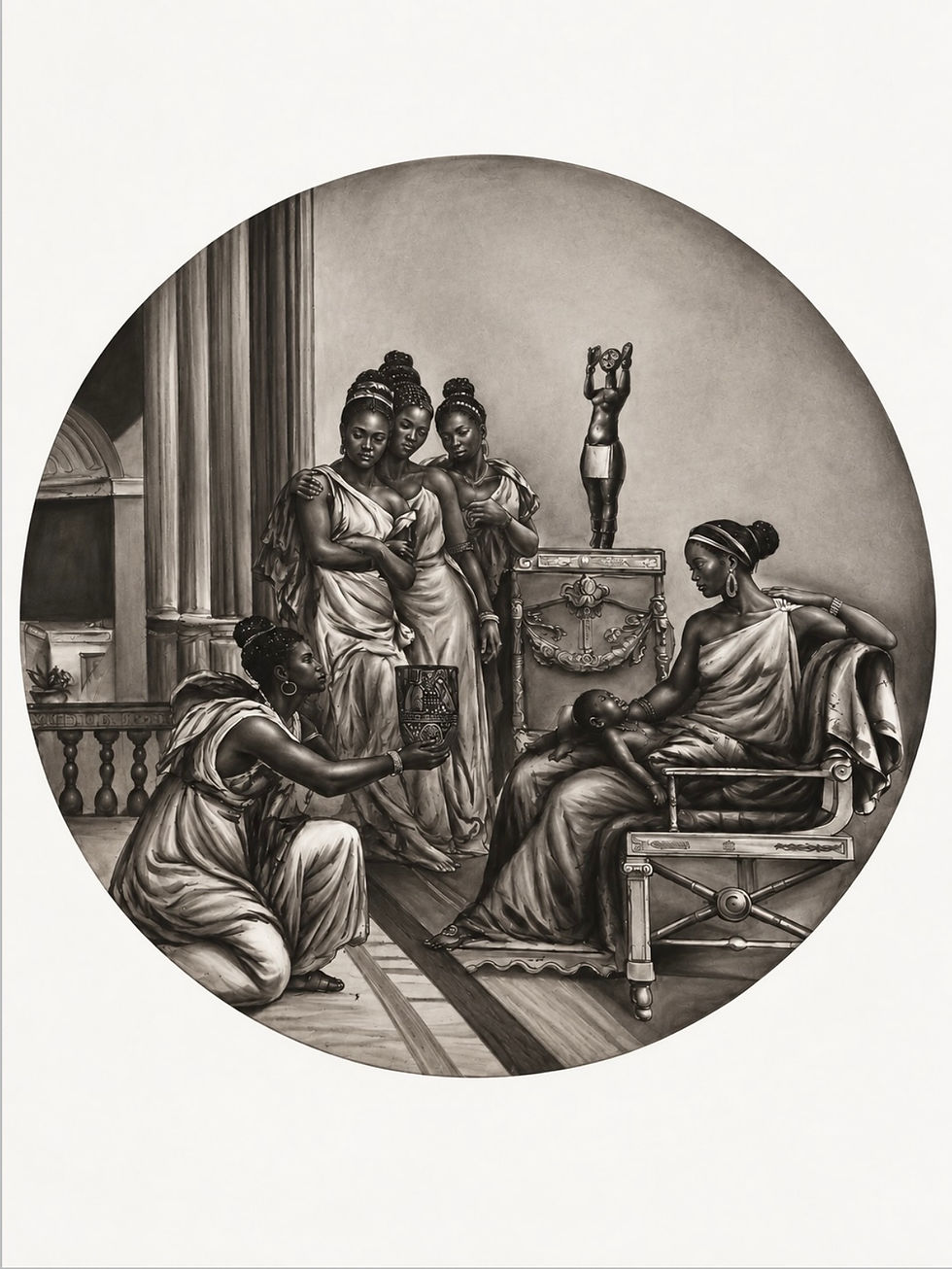
Fhatuwani Mukheli, Carried by Many (An Offering of Peace) (2026)
Oil on canvas
Mukheli was born in Soweto in 1985 and started drawing at seven, after his father painted a portrait of him and his twin brother, Justice. He worked in advertising as an art director before co-founding the creative collective I See A Different You, made specifically to challenge how Black identity was being represented in South African media, and only returned to painting and illustration later, drawing heavily on his own upbringing and the bond between parent and child.
This piece borrows its composition directly from an 1815 French grisaille by Merry-Joseph Blondel and Louis Lafitte, Psyche Presents to Venus a Glass of Water from the Fountain of Youth, a gathering of women rendered in the same round tondo format, the same draped classical fabric, the same grey, painterly restraint. Mukheli has reimagined it through an African and contemporary South African lens, made in response to the xenophobia South Africa continues to experience. At the centre, a mother holds a child, reflecting the African belief that a child is carried by many. The surrounding women represent neighbouring nations, the offered vase becomes a symbol of peace and unity, and above the trunk sits a sculpture by Venda artist Tshivhangwaho Hendrick Nekhofhe, whose figurative woodcarvings reflect the people and life of his community, grounding the whole scene in home, heritage and cultural memory.
What pulled me at first was the size and the round canvas itself, then the faces, each woman caught in a different, specific expression, leaving one reading the relationships and the situation off them before you know any of the backstory, working out who's comforting who, who's watching, who seems to be in need. The story fills itself in before you've been told anything.
There's also something worth naming in the choice to rebuild this specific reference. A 19th century French grisaille, all Neoclassical drapery and Pompeian architecture, comes from a visual tradition that never painted Black women with that kind of softness or dignity. Mukheli borrows the composition and gives these women the same graceful, draped femininity, the same unhurried classical stillness, that the original reserved for its own subjects, and folds in Venda sculpture and African symbolism on top of it, so European classicism, African heritage and a distinctly South African present are all sitting inside one frame together in conversation of a greater story. As Mukheli put it, the work is a reminder that borders may separate us, but we carry one another.
This work argues who gets to be depicted with that kind of grace, using the exact visual language that once withheld it, to make the case for unity across the borders that language was never meant to include.

Vivien Kohler, Ode of Remembrance (2025)
Oil on resin supported canvas.
Kohler was born in Cape Town in 1976, the same year as the uprising this piece depicts, and now lives and works in Johannesburg. He trained at the Ruth Prowse School of Art and Design and works mostly in collage, painting and three-dimensional pieces built from found and discarded materials, with past solo shows carrying titles like De(re)tritus and Residuum, work that consistently returns to fragments, residue and what gets left over. His broader practice explores migration, marginalisation and displacement in post-apartheid South Africa.
The piece takes the form of an ornate blue and gold porcelain plate, the kind with willow-pattern florals and scalloped edges that would come out for a special occasion, except it's shattered into pieces and reassembled with the cracks left visible rather than hidden. Painted into the centre, in the same blue tone as the plate's own pattern, is Sam Nzima's 1976 photograph of Hector Pieterson being carried by Mbuyisa Makhubu, with his sister Antoinette Sithole running beside them, the image that became the defining photograph of the Soweto uprising after Pieterson was shot and killed by police on June 16, 1976.
Placing that image inside a broken heirloom plate makes a private, domestic object of tradition, the kind kept for special occasions and generational continuity, into the vessel for a national wound. But it's not only a wound. June 16 didn't just break something, it also pulled a fractured country toward each other, and that plate, cracked but still whole enough to hold its shape, carries both at once, the loss and what people built out of it together. A broken plate can be pieced back together, but the crack stays visible no matter how carefully it's mended, the same way that pain is still visible in who we are now. Even the history in the photograph never fully resolved, Makhubu,
the boy carrying Pieterson, disappeared into exile a few years later and was never found. The plate can be reassembled. What it's holding never quite goes back to what it was before it broke, but it also never stops being held.

Norman O'Flynn, Fault Lines (2026)
Mixed-media beaded embroidery on cotton.
O'Flynn was born in Cape Town in 1971 and has built his career around a deep, ongoing engagement with pop art, using its bright, seductive visual language to pull viewers in before exposing the excess and unease sitting underneath, celebrity culture, saturation, the low hum of violence normalised by constant screens. Bead and textile work has its own long history on this continent specifically, some of the oldest known beadwork and the oldest known human drawing were both found on the African coast, long before glass beads became a global trade good, small beads of stone, shell, seed and clay were already being threaded and stitched into textiles as decoration. This piece sits inside both histories at once, O'Flynn's usual pop maximalism, rebuilt entirely by hand, bead-by-bead, in a medium with roots stretching back further than the pop tradition he normally works in.
The scene is a lounge pushed to its most saturated extreme, checkerboard floor, patterned sofas, wall-to-wall bookshelves, a Keith Haring print, a woman's portrait, a beaded chandelier, and above it all, a ceiling that opens into deep space, UFOs, radiating light, feather-soft pink and yellow bursts that appear more like a halo than a ceiling. Every object down to the individual book spines is made from beadwork.
What makes the room work as fantasy rather than just spectacle is the labour visible in it. A space built from individually placed beads reads as considered and cared for in a way paint can't quite replicate. That quality of care is also what pushes the room toward something specifically girlhood and womanhood-coded, the kind of interior a girl with her guard still down might imagine for her future, bold, ornamented, entirely unembarrassed about being beautiful and a little unserious at once. The room becomes a dollhouse rebuilt at scale, a space where being playful and being fully yourself aren't in tension with each other. What truly fascinated me, and had me fixated, was the practice of noticing, I realised I could stare at this piece every day and would likely always find a new detail I'd never noticed before.
And it is, definitively, pop art, all the tools are here, bright colour, instantly recognisable imagery, consumer and celebrity culture references. But O'Flynn drops the usual undercutting irony this time, the Keith Haring print, the UFOs, the maximalist styling aren't bait for a rug-pull, there's no second layer waiting to unsettle you. Critics like Ashraf Jamal have described O'Flynn's use of pop imagery as a kind of corrosive lure, the image pulls you in, and then the piece unsettles you once you're inside it. Here, that second half doesn't happen. O'Flynn simply choosing the celebratory register over his usual subversive one, offered as pure, sincere fantasy, which is part of what makes this piece stand apart within his own body of work.
Or so I thought.
The title, Fault Lines, is, by definition, where something is under stress and close to cracking, not a neutral phrase. When paired with that title, the UFOs and the light breaking through the ceiling stop looking purely whimsical and start looking like something pressing in on the room from outside, a domestic fantasy with pressure building against it from above. That would put this piece closer to Jamal's corrosive lure after all, just relocated, the beauty carrying the fracture inside its own title rather than in an obvious visual joke sitting in the room itself.

Bronwyn Katz, kx'ũi domma (2026)
Copper, rope, beeswax, sand, soil, shell fragments and local plant species.
Katz was born in 1993 in Kimberley, South Africa, studied at the University of Cape Town, and is a founding member of iQhiya, a collective of young Black women artists based in Cape Town and Johannesburg. Her practice consistently treats land and material as things that hold memory and trauma, working with found and natural elements, iron ore, driftwood, bed springs, copper wire, to explore how objects and places carry the past. Titling work using actual click consonants from Khoekhoe and other endangered languages is a running thread across her career, not a one-off gesture, a 2019 show was even titled after four click symbols themselves, paired with a looped soundtrack built with a sound artist to fill the exhibition space with clicking, glottal sound.
This piece extends that same project, but with something more personal at its centre. It was a joint winner of the 8th Arnaldo Pomodoro Sculpture Prize in Milan in 2026, alongside all five finalists, an unprecedented decision made partly as tribute to the prize's founder, who died the year before. The installation spreads several radiating, web-like copper structures across the wall, each built from fine looping wire fanning out from a dense central point, with small dark orb-shaped forms scattered nearby, casting long shadows so the whole piece becomes a kind of scattered constellation caught mid-vibration.
Woven into the material is a recording of Katz's great-grandfather's voice, an inheritance made audible, transforming the sculpture into a living archive, a convergence point between personal and collective history. The copper forms function as a kind of portal or notation system, materials activated as elements of a possible language, or an imagined musical score, built to let an endangered language exist again as something living and inherited rather than only archived. The delicate, radiating structures aren't just visually striking on their own terms, they stand in for language and ancestry being physically reactivated, one family's voice given a body to travel through again.


Comments